
Allison Weiss
Game Designer & Artist
The Legend of Zelda: Link’s Awakening (2019)
Up until a couple of years ago, I had never heard of Link’s Awakening, in spite of being a reasonably invested Zelda fan. My first exposure to the game came from the touring “Legend of Zelda: Symphony of the Goddesses” and hearing the “Ballad of the Windfish” performed by a full orchestra. It was beautiful, powerful, and mysterious, and ever since then I have wanted to play the game that first introduced it to the franchise. So for analyzing this game, I went all out, or as all out as you can be while borrowing a friend’s copy of a game. I played the new Link’s Awakening, I researched the original from 1993, as well as the re-release of Link’s Awakening DX of 1998.
I wanted to get as full a picture of the differences in the each iteration, and the context that inspired the original, so that I could deliver an informed analysis and provide an interesting perspective. This post will differ from my previous ones a bit in format because I want to highlight the difference in my approach to what Link’s Awakening brings to the table. And you better believe I am biased, as I am in love with the toy aesthetic. I am ride or die on Team Toy Boy Link.
Differences Between the New and the Old
The Original Link’s Awakening (1993)
The Legend of Zelda: Link’s Awakening for the Game Boy was a game changer for the franchise. Taking inspiration from Twin Peaks, the game focuses on interactions with the Koholint Island inhabitants as a means of progression. You have to help them out for them to help you, perhaps by them lending you their chain chomp-shaped “dog”, or by giving a monkey some bananas, etc.. This inspired almost every narrative-based Zelda that followed it.
But more than that, the handheld release meant that this game acted as the first Zelda game for many who couldn’t afford home systems. It was so successful, in fact, that it went on to sell 3.83 million units by 2004. But many complained about the lack of color, and difficulty discerning what was on-screen (old school Game Boys did not play well in the light).
Despite its success, the game started its development as an unsanctioned side project, made by Kazuaki Morita with one of the first Game Boy development kits. More employees started to joined in their off-time to work on it as well, and after Link to the Past came out in 1991, Takashi Tezuka came on to make a new handheld Zelda title. Though it was originally going to be a Link to the Past port, it ended up becoming its own original game that took them a year and a half to finish.

Link’s Awakening DX (1998)

Link’s Awakening DX for the Game Boy Color was released in 1998 as promotion for the release of the Game Boy Color with several additions on the original. To go along with this, a new dungeon was included, The Color Dungeon, to take advantage of the inclusion of a color palette. Upon its completion, the player would earn Blue Mail or Red Mail that would give them a permanent buff.
The game also added the ability to take pictures in-game and print them out in real life with the use of the Game Boy Printer. But the printing feature was not included in the later Nintendo 3DS digital re-release.
There were other little changes here and there, with stone slabs becoming stone owls, and clouds on the opening title screen, etc.,
The New Link’s Awakening (2019)
The changes present in the 2019 release of Link’s Awakening for the Nintendo Switch are apparent from a glance, updated 3D graphics and Switch controls. The major dungeon addition present in this version comes in the form of a user-generated set of dungeons, that I will get into later on. But unlike the Color Dungeon, which is also revamped in the new version, the rewards for completing them aren’t as useful as a new tunic.
As I recall, the new art-style was met with some debate upon the release of the initial trailers for the game. It’s not hard to understand why some were unconvinced. This game is a remake of one of the most influential Zelda games, if not one of the most influential games of all–according to Guinness Records–and one could worry that major changes wouldn’t properly reflect the love that many hold for the previous editions. But after playing it for myself, I can say that although the style has changed and updated, it still feels like I am playing a handheld game from the 90’s. And the little touches the developers feature in the gameplay enhance that feeling and allow it to feel at once like an homage and a solid Zelda project in its own rites.
Side note: I’m sure that, if you tried, you could get screenshots saved on your SD card developed at a CVS Pharmacy as if it were still the 90’s.

The Significance of Link’s Awakening (2019)
It feels like a bold move to go back and take one of the most influential Zelda games and do a stylized remake. But it has been nearly a decade since it was last released on modern consoles, i.e. the 3DS, and the remake can now serve as the entry for a new generation to Zelda, just as the original did in 1993. I believe the new art style to be a gorgeous and welcome improvement, especially where the soundtrack is concerned, that also serves as a lovingly and intricately crafted homage to its predecessor.
What I absolutely loved…
in the new Link’s Awakening
Snapping Animations While Changing Movement Directions

This is a very specific headline because the specific thing it describes acts as a symptom of what this game does exceedingly well, as well as being the first thing I noticed and appreciated in this game. Link’s Awakening endeavors to be the kind of adaptation that translates the old game into a new style while still maintaining, if not enhancing, the feel of the original.
There are no frames of animation to go in-between Link turning to face a new direction and his sword swipes are extremely fast, basically just a couple frames, similar to how those animations worked in the old-school 2D top-down Zelda games. Seeing that in a 3D game is something I don’t see often, and now I know that I like it. It’s an excellent and simple way to execute retro feel with just a little touch.
That Soundtrack, Oh Boy!
It’s bonkers good. It feels so good to hear, no joke. When that trademark Zelda tune starts playing, I felt joy in my bone marrow. But this installment makes it their own by throwing in these funky instruments.
It’s just so playful, but the melodies often carry this ominous tone that the updated music carries well.
And then you have the whimsical background music from the Animal Village area, a chill video game beat accompanied with dog barks and cat meows which I would gladly have play on a loop in the background of my real life.
Toy Box Aesthetic

I attended E3 this year, and the Nintendo area had the coolest dioramas set up by the systems set up to play Link’s Awakening demos. And if I am being honest, this is what sold me on the art style because it made the characters feel more real, as if I could really reach out and touch them in the game. Setting aside how easy the art style makes merchandising–just sell toys that look exactly like they do in the game–I found it to be an original take on translating the simplicity of the retro 2D designs to a 3D version. And though I can’t reach into the game and grab them, I can go and buy the new Link Amiibo and grab him in real-life.
Things I wasn’t crazy about…
in the new Link’s Awakening
Those Gosh Darn Bottomless Pits
Seeing as this game is 3D and abides by some physics based logic and hitboxes, there are bound to be some hit detection issues. This is most apparent when you come upon the floor tiles with holes in the ground. Sometimes, I was able to quickly sneak myself in between neighboring pits by squeezing through on the sliver of solid ground between them. I tried like the Dickens to do this a lot before I gained the ability to jump. And in the process I began to feel out the tractor beam/pulling force that surrounds the pits that will gradually pull Link all the way in if he gets within the general vicinity. The dimensions of the pulling force’s area of effect feels like a real tightrope walk, as sometimes is will execute its intentions and pull you in, but other times, as I was able to do, you can escape its grasp and take advantage of playing in three dimensions.

Dampe’s Chamber Dungeons

This is the major mechanic-based addition for this adaptation of Link’s Awakening, and I will admit the approach is kind of backwards. You can make your own dungeon, arranging room sets on a board and uploading them so other players can try out your creation. But to collect a new set of rooms you have to beat one of the main game’s dungeons. The players that want the maximum room variety have to play through and complete a whole separate game mode before they can enjoy the new feature. It’s a lot of hoops to jump through and makes dungeon crafting less accessible.
Dampe also assigns design restrictions that the player must follow when arranging their dungeon tiles. Arrange the tiles into a heart shape, for example. Though I don’t have a problem with design challenges, you are required to go in and complete the dungeon you just designed, which is already full of rooms you’ve visited and completed in the main game.
If you choose to see it through, the dungeons you arrange will reach a substantially high number of rooms and the only rewards you receive by completing Dampe’s tasks are two hearts pieces, a bottle, and a bunch of rupees. It just feels tedious and not worth the trouble at the end of the day, and I wish it had taken on more of a Mario Maker approach.
Not Enough Marin

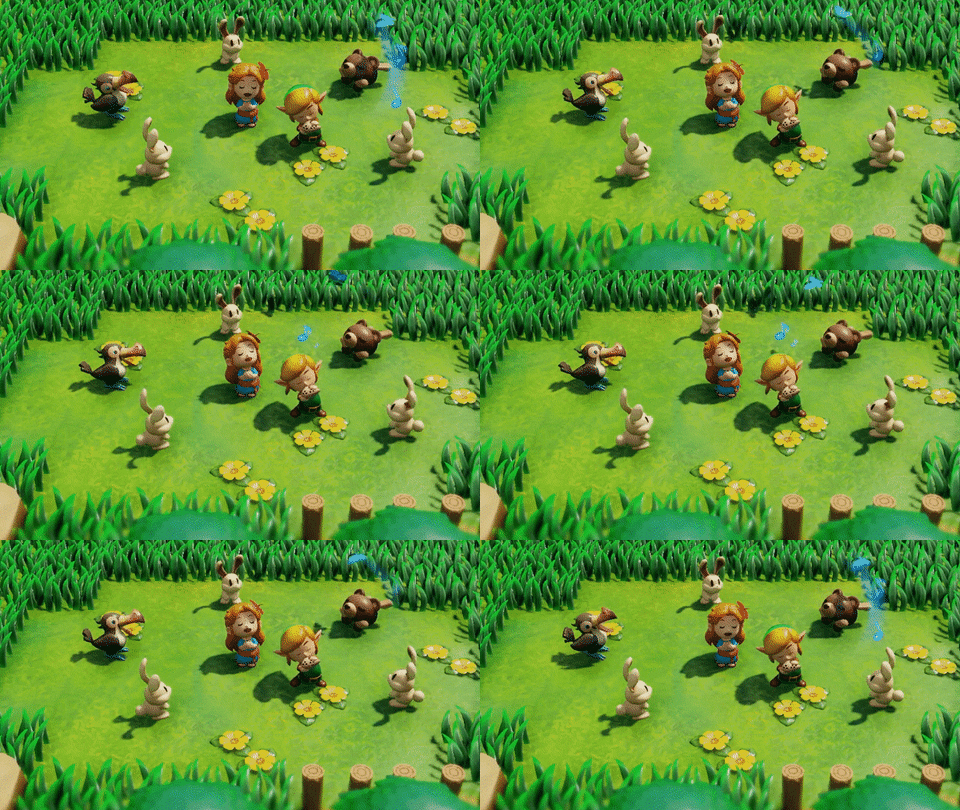
This is Marin. There is not enough of her.
It’s not Nintendo’s fault, though. There truly is never enough Marin.
 Ally Weiss